

Table of Contents
What is an HDMI Modulator?
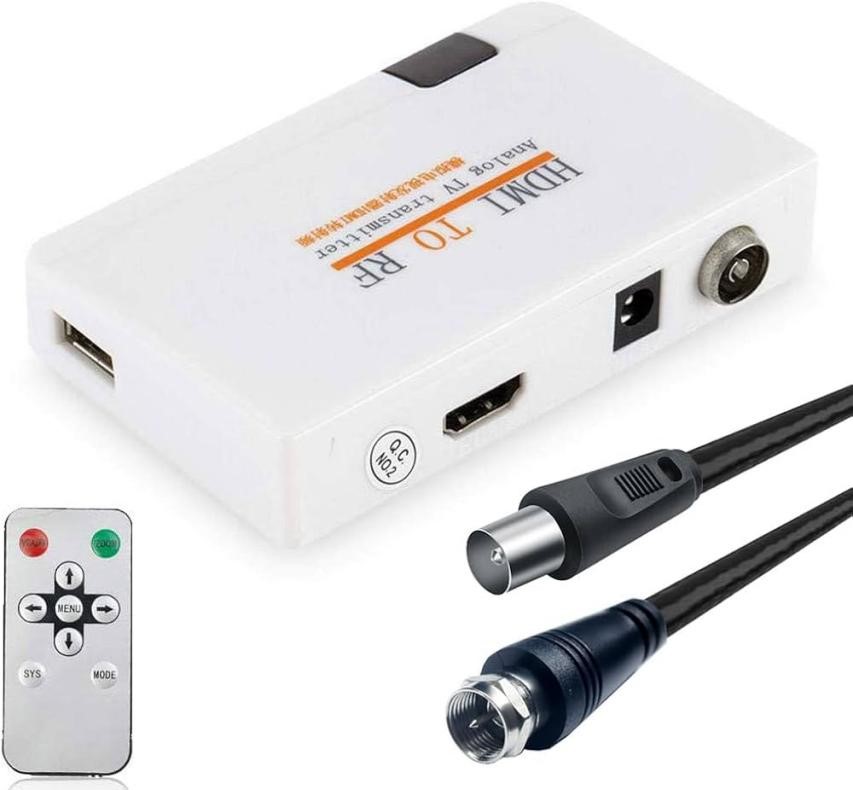
An HDMI modulator, or HDMI RF modulator, converts HDMI signals from devices like Blu-ray players, gaming consoles, or set-top boxes into radio frequency (RF) signals. This allows high-definition audio and video content to be transmitted over coaxial cables, enabling distribution to multiple TVs or monitors in both residential and commercial settings.
The modulator processes the HDMI signal by encoding and modulating it into a suitable RF format, which is then transmitted through coaxial cables to various displays. Key features include maintaining high-definition quality (up to 4K in some models), enabling multi-room distribution without extensive rewiring, and compatibility with older analog systems. HDMI modulators are used in a variety of settings, such as home entertainment, commercial spaces, and healthcare facilities, making them essential for efficiently distributing high-quality video and audio across multiple screens using existing coaxial infrastructure. As an reliable online store, Ersa Electronics will provide variety of RF and Wireless products like RF Modulators, RF Demodulators, RF Antennas, and so on for consumers’ inquiry.
HDMI Modulator Features
HDMI modulators come with a variety of features that enhance their functionality and usability in distributing high-definition audio and video signals. Here are the primary features of HDMI modulators:
High-Definition Video Quality:
Most HDMI modulators support resolutions up to 1080p, with some models offering 4K resolution capabilities, ensuring superior image clarity and detail for high-definition content.
Multiple HDMI Inputs:
Many HDMI modulators allow for multiple HDMI inputs (e.g., 4, 8, 12, or more), enabling the connection of various source devices such as gaming consoles, Blu-ray players, and set-top boxes.
RF Output Options:
The modulator typically provides multiple RF outputs (e.g., 4 or 8 RF outputs) that can be configured to different modulation standards (such as ATSC, DVB-C, DVB-T, ISDB-T), allowing for flexible distribution across coaxial cable systems.
Signal Processing Capabilities:
HDMI modulators perform encoding (e.g., MPEG-4 AVC/H.264) and modulation to prepare the HDMI signal for RF transmission, ensuring compatibility with various broadcasting standards.
Coaxial Output:
The RF signal is output via coaxial cables, making it possible to route the signal to several TVs or displays in both residential and commercial settings, similar to traditional cable TV systems.
Low Latency:
A good HDMI modulator minimizes latency to ensure audio and video synchronization, which is crucial for applications like live broadcasts or video conferencing.
Web Management and Control:
Many modern HDMI modulators feature web-based management interfaces that allow users to configure settings, monitor performance, and perform updates remotely, enhancing usability and convenience.
PID Remapping and Filtering:
Advanced features may include PID remapping capabilities and null packet filtering, allowing for precise control over data streams and improving overall signal quality.
User-Friendly Interface:
Many devices come with an intuitive graphical user interface (GUI) for easy setup and management, making it accessible even for users without extensive technical knowledge.
Compatibility with Analog Systems:
Some models can bridge modern HDMI devices with older analog systems, enabling seamless integration without requiring complete system overhauls.
HDMI Modulator Applications
HDMI modulators are versatile devices that enable the distribution of high-definition audio and video signals across various environments. Here are some of the primary applications of HDMI modulators:
Home Entertainment Systems:
Multi-Room AV Distribution: HDMI modulators allow homeowners to send video from a single source (like a Blu-ray player or streaming device) to multiple TVs in different rooms, providing seamless entertainment without the clutter of multiple HDMI cables.
Home Cable TV Systems: They can integrate with home cable TV setups, enabling set-top boxes and other HDMI sources to distribute HD content to several TVs throughout the home.
Commercial and Public Spaces:
Hotels and Hospitality: HDMI modulators are commonly used to distribute high-definition video from a central source (such as a media server or satellite receiver) to multiple TVs across hotels, enhancing guest experience with quality audio and video content.
Digital Signage: In retail environments, stadiums, airports, and other public spaces, HDMI modulators broadcast digital signage content to multiple screens via coaxial cable networks, allowing for centralized content management.
Security Monitoring Systems: They facilitate centralized monitoring by allowing multiple monitors to receive video signals from surveillance cameras, which is crucial for security operations.
Educational Institutions:
Campus TV Systems: Colleges and universities utilize HDMI modulators to distribute educational content, live broadcasts, and announcements throughout campus television systems, ensuring that all classrooms and common areas receive the same material simultaneously.
Healthcare Facilities:
Hospitals and healthcare facilities use HDMI modulators to provide information and entertainment to patients in their rooms. This system allows for centralized distribution of content from a single server to multiple patient rooms, enhancing patient comfort.
Event Venues:
HDMI modulators are essential in large venues such as sports arenas, convention centers, and concert halls for multi-display live event broadcasts. They enable attendees to view events from various locations within the venue.
Advantages and Disadvantages of Using an HDMI Modulator
Using an HDMI modulator comes with various advantages and disadvantages that can influence its effectiveness in different applications. Here’s a summary based on the information provided:
Signal Distribution:
HDMI modulators allow the distribution of high-definition content over existing coaxial cables, making them ideal for large venues such as hotels and hospitals where extensive rewiring is impractical.
Multiple Device Connectivity:
They enable the same HDMI signal to be sent to multiple TVs or devices without the need for additional HDMI splitters, simplifying setup and reducing cable clutter.
Cost-Effective for Large Installations:
Utilizing existing coaxial infrastructure can be more economical than installing new HDMI cabling, especially in environments with many displays.
Long-Distance Transmission:
HDMI modulators can transmit signals over longer distances without significant quality loss, unlike standard HDMI cables that may degrade over long runs.
Channel Assignment:
Users can assign specific RF channels for the HDMI signals, allowing easy tuning on connected TVs or receivers.
Compatibility with Older Systems:
They can bridge modern HDMI devices with older analog systems, enabling integration without replacing all existing equipment.
Flexible Installation:
The modulator can be placed near the HDMI source, with coaxial cables capable of transmitting signals long distances without quality degradation.
Disadvantages of Using an HDMI Modulator
Quality Loss:
The conversion from HDMI to RF can lead to some loss in signal quality due to compression, particularly with lower-quality modulators.
Resolution Limits:
Some modulators may not support full HDMI resolutions, potentially limiting output to 1080p or lower, which may not meet the needs of users seeking higher resolutions like 4K.
Complex Setup:
Setting up an HDMI modulator can be more complex than direct HDMI connections, requiring careful configuration for channel assignment and signal quality management.
Interference Issues:
RF signals can be susceptible to interference from other devices, which may degrade the quality of the transmitted signals.
Latency:
There may be a slight delay in signal transmission, which could be problematic for time-sensitive applications such as gaming or live streaming.
Cost Considerations:
While they can be cost-effective for large installations, standalone HDMI modulators can be expensive, particularly high-end models with advanced features.
Main Differences Between QAM and ATSC Modulation in HDMI Modulator
The main differences between QAM (Quadrature Amplitude Modulation) and ATSC (Advanced Television Systems Committee) modulation in HDMI modulators lie in their applications, transmission methods, and data handling capabilities.
Definition and Purpose
QAM is primarily used for cable television systems. It combines amplitude and phase modulation to transmit data over coaxial cables, allowing for high data rates. In contrast, ATSC is a standard for over-the-air digital television broadcasting, utilizing 8-VSB (8-level Vestigial Sideband) modulation to deliver signals received via antennas.
Transmission Medium
QAM is designed for wired connections, making it suitable for environments like cable TV networks where multiple channels can be transmitted simultaneously. ATSC, on the other hand, is intended for over-the-air broadcasts, which means it must effectively handle signal degradation caused by obstacles and interference in the environment.
Data Rate
QAM can support higher data rates, typically around 38.4 Mbps, allowing it to transmit multiple HD channels or several standard-definition channels simultaneously. In comparison, ATSC generally supports lower data rates of about 19.2 Mbps, which is sufficient for a single HD channel or several SD channels.
Signal Characteristics
The QAM signal appears as a stable constellation of points on a scope, indicating its robust performance in cable systems with minimal interference. ATSC signals appear more scattered due to their design to cope with various environmental factors that may affect over-the-air transmission.
Compatibility
Both QAM and ATSC are compatible with modern digital tuners; however, most low-cost tuners tend to support only ATSC for off-air signals while requiring specific setups to handle QAM channels. Additionally, mixing these two types of signals on the same RF cable can lead to compatibility issues since they operate on different frequency ranges.
Use Cases
QAM is ideal for cable television systems where high data throughput is necessary and interference is less of an issue. ATSC is better suited for broadcasting scenarios where signals must navigate through various obstacles and maintain integrity in diverse reception conditions.
What are the common issues faced with HDMI modulators
HDMI modulators, while beneficial for distributing high-definition audio and video signals, can encounter several common issues. Here are some of the most frequently reported problems:
1. No Signal Output
One of the most prevalent issues is the absence of signal output to connected displays. This can occur due to loose or damaged HDMI cables, incorrect input selection on the TV, or power issues with the modulator itself.
2. Signal Quality Degradation
Users may experience a decline in signal quality, which can manifest as pixelation, artifacts, or a complete loss of video/audio. This degradation often results from poor-quality cables, interference from other electronic devices, or inadequate modulation settings.
3. Resolution Limitations
Some HDMI modulators may not support higher resolutions, limiting output to 1080p or lower. This can be particularly problematic for users expecting to transmit 4K content.
4. Compatibility Issues
Compatibility problems can arise when connecting different devices, especially if they do not adhere to the same HDMI standards. Users might find that certain devices do not work together, leading to signal failures or distorted images.
5. Handshake Problems
HDMI devices rely on a series of handshakes to establish a connection and negotiate settings like resolution and audio format. If these handshakes fail (often due to HDCP issues), users may encounter black screens or error messages indicating an incompatible signal.
6. Input Switching Delays
When switching between multiple input sources, users may experience delays that can be frustrating, especially during live broadcasts or gaming sessions.
7. Signal Dropouts
Intermittent loss of video or audio signals can occur due to various factors such as cable quality, length, or interference from nearby electronic devices.
8. Overheating
HDMI modulators can overheat if not placed in well-ventilated areas or if they are used continuously for extended periods. Overheating may lead to performance issues or unexpected shutdowns.
9. Firmware Issues
Outdated firmware can result in bugs and performance problems. Regular updates from the manufacturer are necessary to ensure optimal functionality and compatibility with new devices.
10. Power Supply Problems
Inadequate power supply or fluctuations can affect the stability and performance of HDMI modulators, leading to intermittent operation or failure to power on.
You can also read the below tutorials.

Embedded Software | Firmware | Linux Devic Driver | RTOS
Hi, I am a tech blogger and an Embedded Engineer. I am always eager to learn and explore tech-related concepts. And also, I wanted to share my knowledge with everyone in a more straightforward way with easy practical examples. I strongly believe that learning by doing is more powerful than just learning by reading. I love to do experiments. If you want to help or support me on my journey, consider sharing my articles, or Buy me a Coffee! Thank you for reading my blog! Happy learning!
Share this:

Discover more from EmbeTronicX
Subscribe to get the latest posts sent to your email.