

If you read this tutorial, you will come to know the answer to How Do Vector Databases Work?
Table of Contents
Introduction
In today’s data-driven world, there is an increasing need to collect more types of data than ever before. The rapid evolution of artificial intelligence, machine learning, and big data has meant that traditional databases are struggling to store vast data sets or organize them in a way that can train and power the latest technological innovations. One of the databases that is becoming increasingly vital in this digital revolution is the vector database. A vector database is a database management technology used to store, manage, and search vectors, which are numerical representations of unstructured data. This allows machine learning models to understand data contextually. Despite dating back to the early 2000s, the vector database has only become a known system in recent years. Yet its popularity is rising fast. Worth $1.98 billion in 2024, the value of the vector database market is expected to be $5.76 billion by 2028 as more industries invest in these databases. Here is how a vector database works.
Applications
- Vector databases are designed to store and organize unstructured data. 80% of all data is unstructured, and this includes documents, video, audio, PDF files, and any sort of text.
- A vector database can perform similarity searches.
- It can train generative AI models and be the data source for recommendation systems.
Components of a Vector Database
Vector
A vector is a quantity with both magnitude (or size) and direction and is represented in a vector database as a list of numbers in a multiregional space. Any type of data can be represented by a vector.
Embedding Model
The embedding model is the process of converting data into numbers, where each data point is represented by a vector in high-dimensional space. The vectors can then be organized and stored in an index for fast retrieval or a similar search.
Vector Index
As a vector database can hold millions of embeddings, it would be very time-consuming to search through each vector manually to find the nearest one to your search query. A vector index is a data structure that organizes the data by breaking down the vectors and grouping them together into clusters to enable the similarity search process.
How a Vector Database Works
How the Data is Inputted
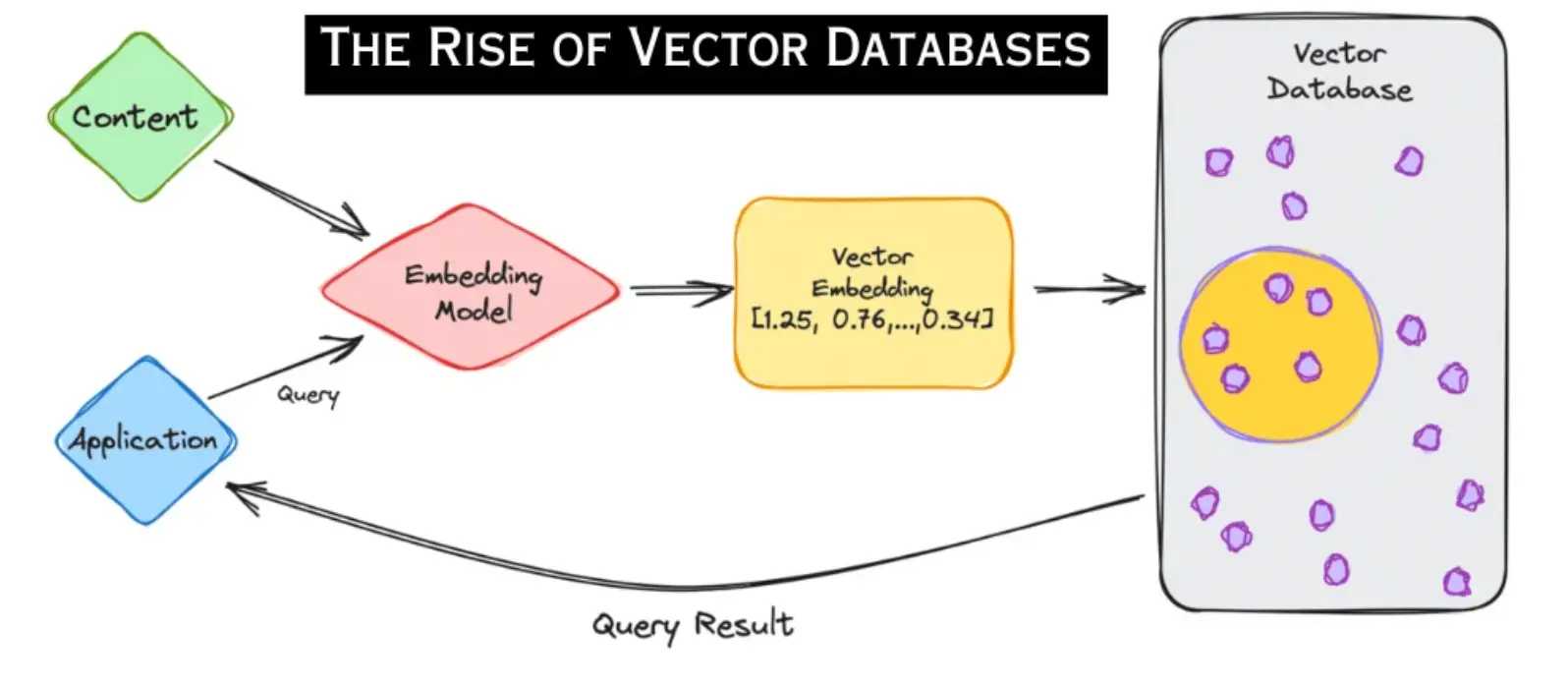
The desired content—in this case, a library of films—is entered into the database. The embedding model turns each film into a vector, a long list of numbers that includes multiple data points—i.e., film title, length, actors, and genre. This vector for each film is then broken down in the index into smaller vectors based on similarities. For example, all horror films are clustered together, and all films with the same actor are clustered together.
How a Vector Database Performs a Similarity Search
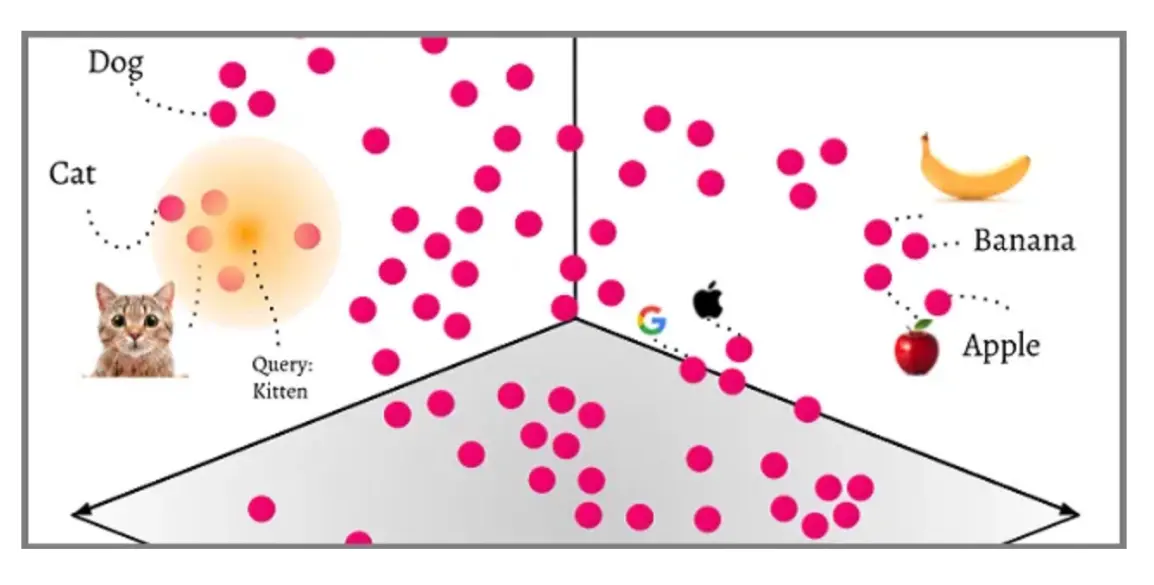
A similarity search is a key feature of vector databases. Using the above diagram, this database features multiple data points on different subjects. Among the data inputted are different pets and different fruits. Each data point here is a vector, which, through the embedding model, has become a list of numbers. These vector numbers have been broken down by the index and clustered together based on similarity. As the above graph shows, all vectors related to pets are grouped together, and within this group, all vectors related to individual pets are clustered together. So when a user enters the query kitten, the database will run an approximate nearest neighbor (ANN) search to quickly identify all vectors related to kittens without the need to scan every vector in the database. In the fruit index, note how the company Apple, a vector from a different tech group, is positioned near the apple fruit vector. If a user were to query the word apple, the database would find all the vectors related to that world from the fruit and tech clusters.
Who Uses Vector Databases
The ability to hold vast amounts of spatial and geometric data has made the vector database very popular in many different industries. Online tools that assist developers are becoming increasingly common, and a vector database will likely support an online tool using an LLM to provide answers and write code. This is because a vector database will keep the online tool up to date with constantly inputted information. Online retailers use vector databases to provide personalized service through recommendations. The database can use the vectors to store a customer’s previous purchases and browsing habits to recommend items they may like. The same applies to streaming services, which hold data on a user’s viewing history to recommend content. In finance, institutions can analyze a client’s portfolio to make investment decisions based on their spending habits and risk tolerance. Banks can also use vector databases to detect fraud by comparing transaction data with recognized fraud patterns. Healthcare systems are also investing in vector databases to enhance research capabilities and improve patient care and treatment. For example, a similarity search can be used to see which treatments worked for different patients with the same condition.
Vector databases are the future of data management and if you want to stay ahead you need to learn how they work and how they can be applied to different applications. For more lessons do go through our tutorials and educate yourself on the latest innovations and coding in the tech world.
You can also read the below tutorials.

Embedded Software | Firmware | Linux Devic Driver | RTOS
Hi, I am a tech blogger and an Embedded Engineer. I am always eager to learn and explore tech-related concepts. And also, I wanted to share my knowledge with everyone in a more straightforward way with easy practical examples. I strongly believe that learning by doing is more powerful than just learning by reading. I love to do experiments. If you want to help or support me on my journey, consider sharing my articles, or Buy me a Coffee! Thank you for reading my blog! Happy learning!
Share this:

Discover more from EmbeTronicX
Subscribe to get the latest posts sent to your email.